kenzoAI Overview
kenzoAI is an AI-powered developer intelligence platform that embeds LLM-driven insights directly into the software development lifecycle. It analyzes source code, build configurations, and build logs to identify issues that impact productivity, helping teams deliver higher-quality software faster and with fewer resources.
The platform diagnoses build failures by interpreting logs, explaining root causes in plain language, and recommending practical fixes. It can also forecast the likelihood of build failures by analyzing code changes between commits, enabling teams to address risks early.
Available as a SaaS solution, kenzoAI integrates seamlessly into existing development workflows, allowing teams to access insights without changing how they build or deliver software. By reducing debugging time and optimizing resource usage, it minimizes wasted compute and improves overall development efficiency.
kenzoAI’s vision is to make intelligence accessible to teams of all sizes, supporting a shift from reactive debugging to proactive issue prevention. This allows developers to focus on building new features and delivering value instead of repeatedly resolving avoidable issues.
What can you do with kenzoAI?
kenzoAI enables teams to proactively manage build reliability and development risk by turning raw development data into clear, actionable intelligence. With kenzoAI, you can:
- Detect potential build and code issues early by analyzing code changes between commits, using percentage-based thresholds to identify risk.
- Prevent build failures by identifying problems before they impact development workflows.
- Receive plain-language explanations of build failures, root causes, and build configurations.
- Reduce noise, optimize compute usage, and shorten debugging cycles.
Why Developer Intelligence
Traditional development workflows surface problems only after a build fails. This leads to reactive debugging, longer resolution cycles, and unnecessary consumption of compute resources.
Developer intelligence addresses this gap by analyzing recent code changes, build configurations, and build logs to anticipate failures before they occur. Instead of reacting to broken builds, teams gain early visibility into risk introduced by recent changes and can address issues while context is still fresh.
By proactively identifying potential failures and reducing time spent diagnosing issues, kenzoAI helps teams maintain momentum, improve build reliability, and deliver software with fewer interruptions.
How kenzoAI Works
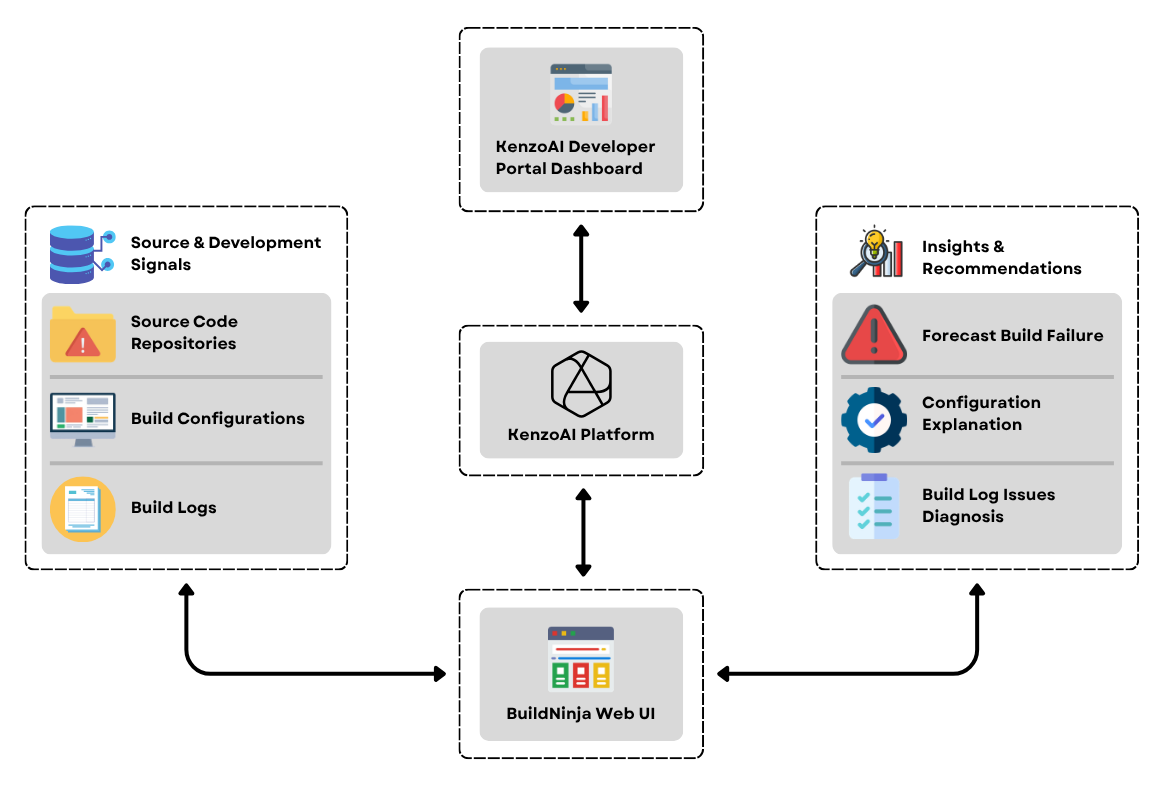
kenzoAI uses LLM-based reasoning to analyze recent code changes, build configurations, and build logs across the build lifecycle:
- Failure Prediction: Analyzes recent code changes to predict the likelihood of build failure as a percentage.
- Configuration Analysis: Evaluates build configurations to help teams understand how settings, dependencies, and execution parameters affect build behavior.
- Log Analysis: When a build fails, interprets build logs to explain the root cause in plain language and suggests actionable fixes.
By combining these analyses, kenzoAI gives teams a clear picture of why a failure is likely to happen or why it already occurred. The diagram below illustrates kenzoAI's intelligence flow.
kenzoAI vs Traditional CI/CD and Monitoring Tools
Traditional CI/CD and monitoring tools primarily report failures after execution and provide raw logs for manual investigation. kenzoAI goes further by:
- Predicting build failure likelihood based on recent changes.
- Explaining build failures and configuration in clear, human-readable terms.
- Reducing the need to manually sift through logs and configuration files.
This enables teams to prevent failures earlier and resolve issues faster, rather than reacting only after builds break.
When to Use kenzoAI
kenzoAI is most valuable in environments where build reliability and developer productivity are affected by complexity or limited visibility. Use kenzoAI when:
- Builds fail frequently and root causes are difficult or time-consuming to identify.
- CI pipelines rely on complex or evolving build configurations.
- Teams spend significant time manually reviewing build logs.
- Build failures lead to wasted compute time and slower delivery cycles.
- Engineering teams want earlier insight into failure risk introduced by recent changes.
Quick Navigation
kenzoAI Platform Model
Explore kenzoAI’s application model, access control, and limits.
Explore Platform Model →